


Introducing Koji Lau-Ozawa
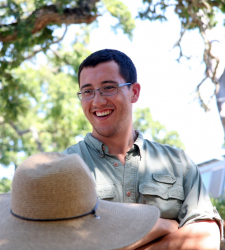
Koji Lau-Ozawa, assistant professor of anthropology, brings an uncommon perspective to his research and teaching on the Japanese diaspora and the intersections of Japanese-American incarceration and indigenous lands. In addition to his studies, he is informed by his late grandmother, who was incarcerated at a camp in Arizona during World War II.
Lau-Ozawa, who is starting his first year of teaching at UCLA, is also setting up a tentatively-titled Asian Diaspora Archaeology Lab to help support some of the research he has been doing, specifically on the intersections of Japanese-American incarceration and indigenous lands during World War II. “I think the intersections between the incarceration camps and indigenous reservations have, until recently, been under explored,” he explained.
“The primary site I worked on during my first project was on the Gila River incarceration camp constructed on the Gila River Indian Community Reservation,” which was one of two main camps built on native reservations, according to Lau-Ozawa. “Another site that I’ve been working on in collaboration with colleagues at Arizona State University and Berkeley is called Old Leupp. It was formerly a federal Indian boarding school on the Navajo Nation that was converted into an isolation center for Japanese-American citizens,” he continued.
Despite opposition from the tribal governments, “it was clear that the camps and prisons were going to be constructed anyway, so they were coerced into formal agreements with the government.” Most of the camps were open from 1942 to 1945, and the detainees were from Central California, the Sacramento area, and Southern California.
“President Roosevelt signed Executive Order 9066 in February, 1942, which created an exclusion zone along the West Coast and gave the power to the Western defense command to exclude anybody from the zone,” Lau-Ozawa continued. “The executive order included impossibly or frustratingly broad language that gave the U.S. military under the Western defense command wide latitude to decide how to enforce it. So mostly German and Italian nationals and people of German and Italian descent were given curfew and travel restrictions. But the military decided that no one of Japanese ancestry could be trusted in any capacity and that they had to be ‘removed’,” he explained. Eventually they even took babies out of orphanages and built orphanages in the camps, he added.
This upcoming quarter, Lau-Ozawa will be teaching a writing course within the Lemelson Undergraduate Honors Program. “I’ll be teaching the current program cohort in writing and anthropology during their penultimate quarter in the program. The course is really targeted at how to write up research in anthropology, which is a critical skill.,” he explained. “There’s no point in doing research if you can’t communicate it to either your colleagues or the public.”
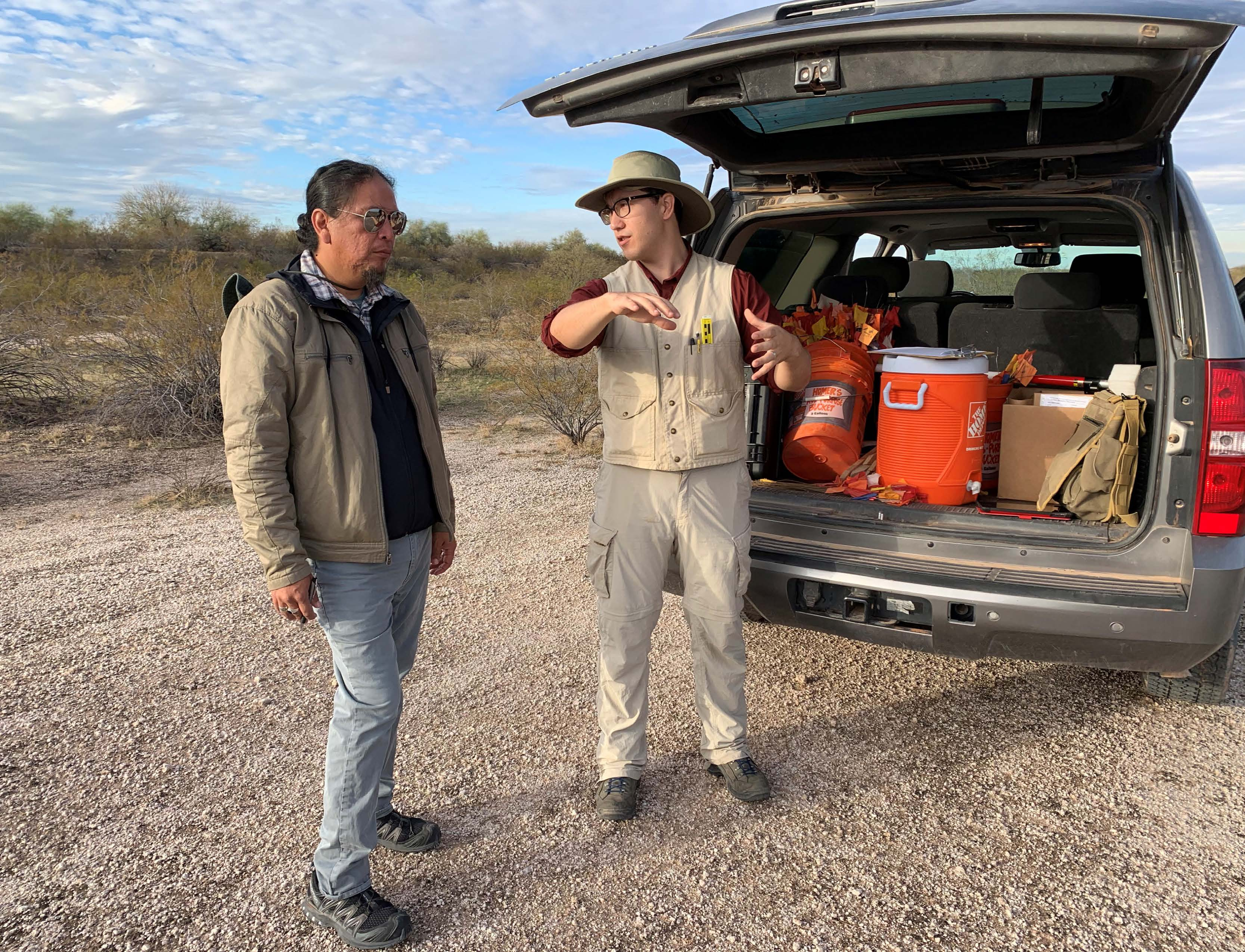 Lau-Ozawa grew up in the San Francisco Bay Area. He developed an interest in archaeology and anthropology while in high school and volunteered at an excavation in the San Gabriel mountains between his junior and senior years. When it came time to apply for a university, he thought it would be a great opportunity to see the world from a different perspective and to meet people from around the world. This ambition led him to do his undergraduate work at the University of Edinburgh in Scotland. He added that, at that time, it was actually a little less expensive to study in the UK than to study at a UC as an in-state student.
After his undergraduate studies, he returned to California and worked for several years in archaeology, during which time he pursued a master’s degree at San Francisco State University and then a PhD at Stanford University, awarded in 2023. From Stanford, he was accepted to the UC President’s Postdoctoral Fellowship Program. During his fellowship, he did interviews and talks at many of the UC campuses and “was fortunate that UCLA’s Department of Anthropology was interested and offered me a position.”
He added that he was “very excited to come here where he has “great colleagues in anthropology and in the Cotsen and a lot of exciting research that I think aligns with many of the themes and methodologies that I explore in my research.” He has been at UCLA for two years just doing research, so this will be his first year as a faculty member teaching.
In addition to the Lemelson honors writing course, he will be teaching a graduate seminar around materiality in the recent past: archaeology focused on how we think of objects, things, and materials in the last 200 years and how we study them and relate to them today. During the course, one of the areas he plans to address is the tension or dynamics around museums, archaeologists, communities, and collections in terms of desires, resources, the crisis of space, access for community members, and the appropriateness of what should be taken and what should be left, as well as who gets to make those decisions. “What is our responsibility as an institution that does research, that prioritizes dissemination of information and learning, to best do that keeping these communities in mind? All very complex issues,” he noted.
“I think it was Orwell who wrote that those who control the past will control the future. So this topic and discussion feels very pertinent, and looking at the camps and mass deportation also feels extremely pertinent,” he added.
He will also be teaching an undergraduate course on the internment camps. “We will be looking at how we understand them from the experience and the materials; the sort of ethnographic and archaeological modes of research and how different camps have been used by governments for a variety and range of purposes. How did those experiences impact the people who moved through them?” Toward this end, Lau-Ozawa has conducted many oral history interviews with both camp survivors and descendants. “The camp I work at in Arizona is actually the camp in which my family was incarcerated. Before she passed away at 103, I interviewed my grandmother who was in the camp in her twenties. She even had a photo album from her time in camp. My uncle actually was born in the camp.”
Published on January 27, 2026.