


Event: WEDS TALKS: Archaeologies of the Colonial City in South Asia: Mapping Architecture and Social Difference in Portuguese Chaul
Date & Time
May 27, 2026 - 12:00am to 1:00pm Save to your calendar
Contact Information
Sumiji Takahahshisutakahashi@ioa.ucla.edu
310-825-4169
Location
Fowler A222 (Seminar Room)Event Type
Pizza TalkEvent Details
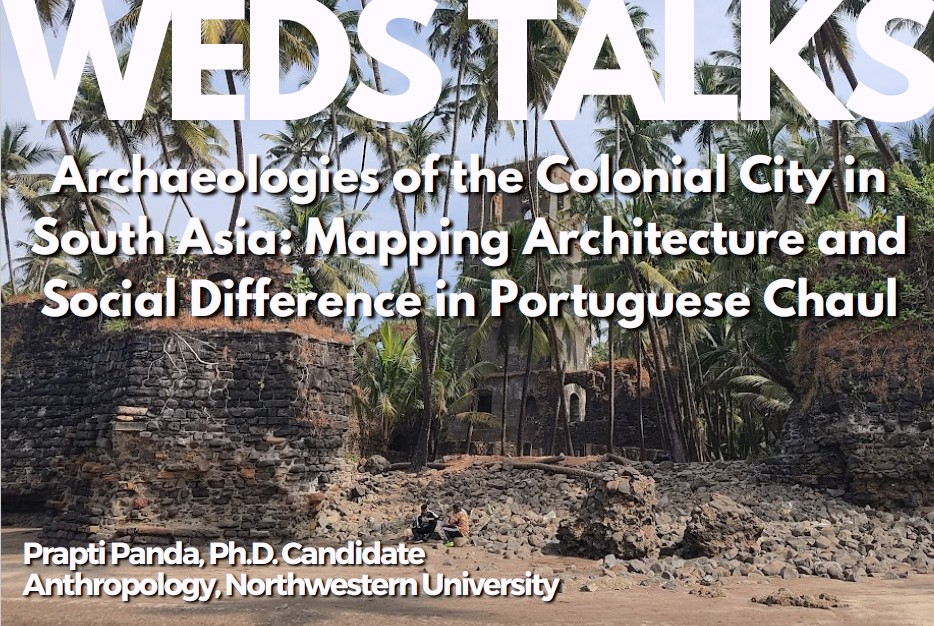
ABSTRACT: Between the sixteenth and eighteenth centuries, port-cities in the Indian Ocean became critical nodes in expanding trade networks linking Africa, the Middle East, South Asia, and Europe. Among these were emerging European colonial settlements, where imperial regimes attempted to order large and mobile populations of merchants, artisans, fishermen, religious communities, and landholders whose labor sustained global exchange. Scholarship on these early colonial cities in South Asia has largely emphasized forts, churches, and administrative architecture, drawing on colonial archives that foreground elite European perspectives. This talk revisits colonial urbanism in South Asia through the archaeological landscape of Chaul, a Portuguese port-city on India’s western coast (occupied 1510-1740). Drawing on ongoing archival and archaeological work, I explore how the built environment can offer new ways of approaching social difference and inequality during colonial expansion, focusing on the configuration of domestic architecture and neighborhoods. Although imperial regimes often aspired towards ordered and legible urban landscapes, the cities that emerged through colonial settlement were by no means homogenous. Through the case of Chaul, I explore how historical archaeology can illuminate the plural resident communities and everyday spatial negotiations that shaped colonial urban life in early modern South Asia.
BIO: Prapti Panda is a PhD candidate in Anthropology at Northwestern University. Trained as a historical archaeologist, her research focuses on colonial urbanism, heritage politics, and architectural history in coastal western India. Her ongoing doctoral research has received support from institutions including the Luso-American Development Foundation and the American Philosophical Society.