


Past Events
Interested in Cotsen events? Sign up for our mailing list.SPEAKER:
John Cherry
Professor of Archaeology and Classics
Joukowsky Institute, Brown University
ABSTRACT:
Until quite recently, archaeologists have supposed that the seas and oceans represented a barrier to human dispersal, and that islands were among the last places on earth to be colonized by people, only fairly recently, as part of the worldwide spread of modern humans. But is that picture still correct? Startling new data have come to light just in the last few years, in parts of the Mediterranean and in island Southeast Asia, that have been claimed as evidence for a far longer antiquity for seafaring, reaching back hundreds of thousands, and perhaps as much as a million years. Naturally, these claims have attracted widespread attention and much discussion — and not only among archaeologists. This lecture outlines what we know, with reasonable certainty, about patterns of global maritime dispersal in the past few tens of thousands of years, before turning to present the new evidence and its strengths and weaknesses. In trying to understand it, we will need to consider information (amongst other things) from ethnographic analogy, experimental seafaring, and our current knowledge of the relative configurations of land and sea over the course of the Pleistocene era. Some of the bold assertions made in the past few years require more supporting data before they can be accepted. That cautious conclusion does not detract from the excitement and importance of this fast-moving field of research in archaeology.
Contact Aaron A. Burke (aaburke@ucla.edu) for more information.
Contact Sumiji Takahashi
Phone 310-825-4169
Mariana Favila Vázquez
Archeological studies regarding pre-Hispanic mechanisms of environment appropriation have been crucial to explain the complexity of Mesoamerican societies. However, an ontological dichotomy of water and land has permeated these investigations for decades. The activities practiced on the mainland, such as agriculture, among many others, are the preferred focus of interest for explaining indigenous social and historical processes. The activities and the role of the aquatic spaces are generally considered subordinate or secondary concerning the former. Through archaeological, iconographic and historical
evidence this paper argues that Mesoamerican cultures, such as the Olmec, Maya, and Aztec, had a perception of the environment in which, although water was of course distinguished from the mainland, it was not seen exclusively as an opposite space, liminal and independent to the political, social, economic and religious dynamics of the indigenous people. Evidence of this is the development of a complex nautical technology that was permeated by the religious and ideological configurations of the societies that produced it. Consequently, navigation was practiced as a landscape connectivity system that integrated the use of waterways, coastal lagoons, wetlands, and estuaries, along with roads and activities in the mainland. This study allows for rethinking the valuation of aquatic spaces and getting closer to the local perception of the environment, in which the aquatic spaces are no longer the limit of the territories inhabited by humans.
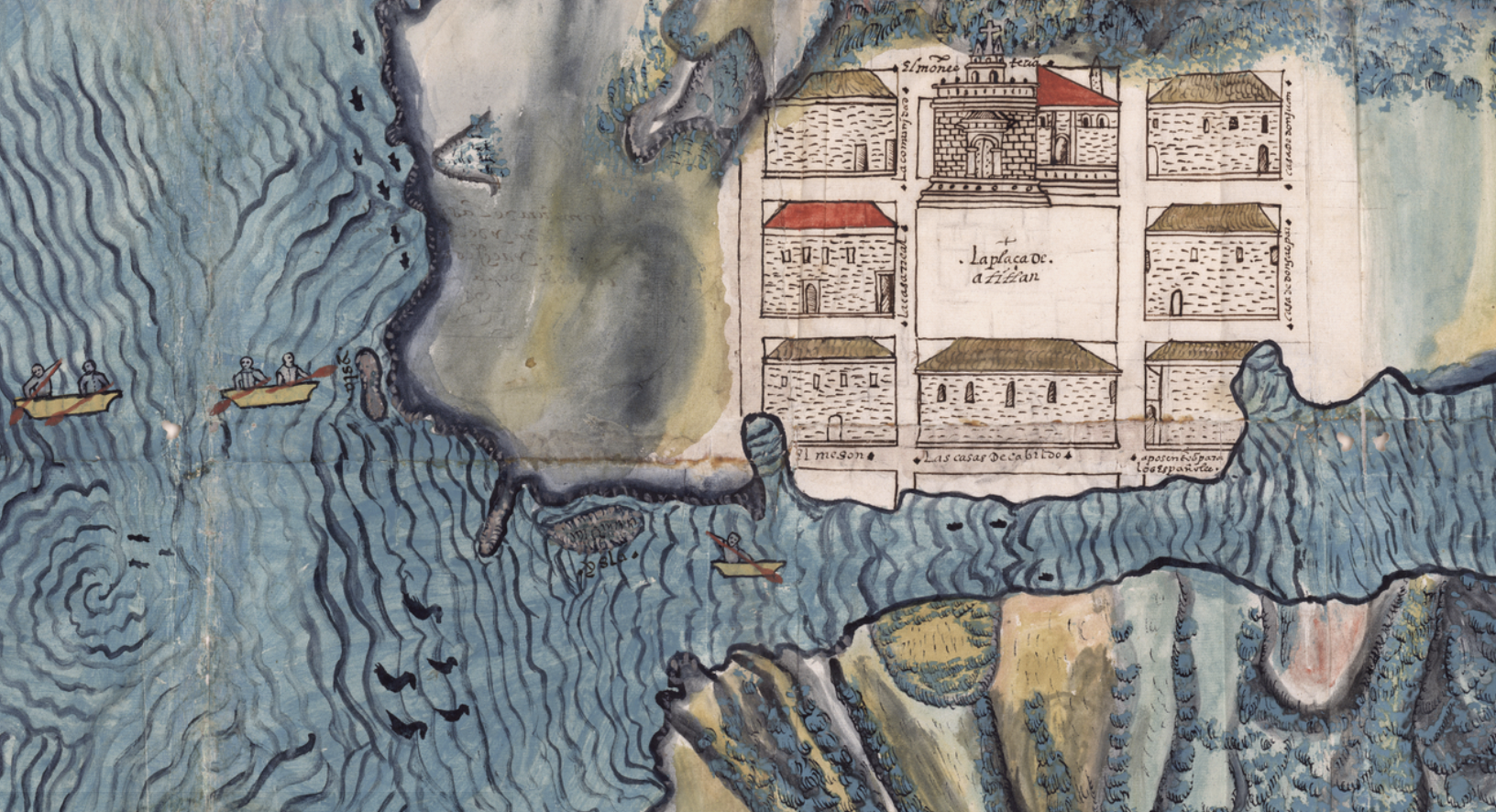
This talk is part of the El Mar Y Sus Metáforas Series and will be in Spanish. For more information about this talk or series, please contact Jimena Rodriguez.
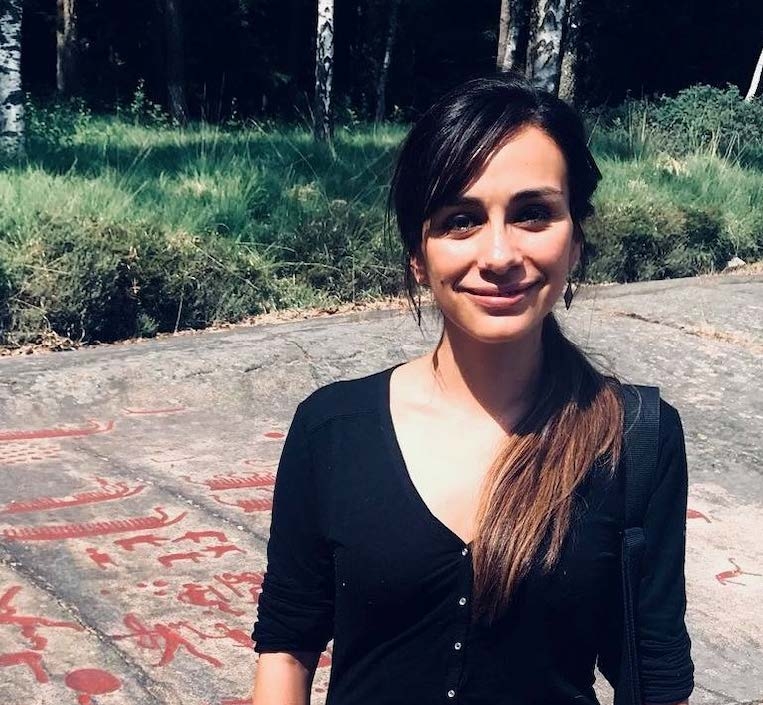
Mariana Favila Vázquez is a Professor of Archeology at the ENAH (National School of Anthropology and History, México) and a research associate in the project “Digging into early colonial Mexico: a large-scale computational analysis of 16th century historical sources” of the University of Lancaster, United Kingdom and the Museo de Templo Mayor in Mexico. Her research has focused on indigenous pre-Hispanic and colonial navigation traditions in the Mesoamerican cultural area.
This talk is co-sponsored by the UCLA Latin American Institute, the Cotsen Institute of Archaeology and the Department of Spanish and Portuguese.
Contact Jimena Rodriguez
Email jimenarodriguez@ucla.edu
Phone
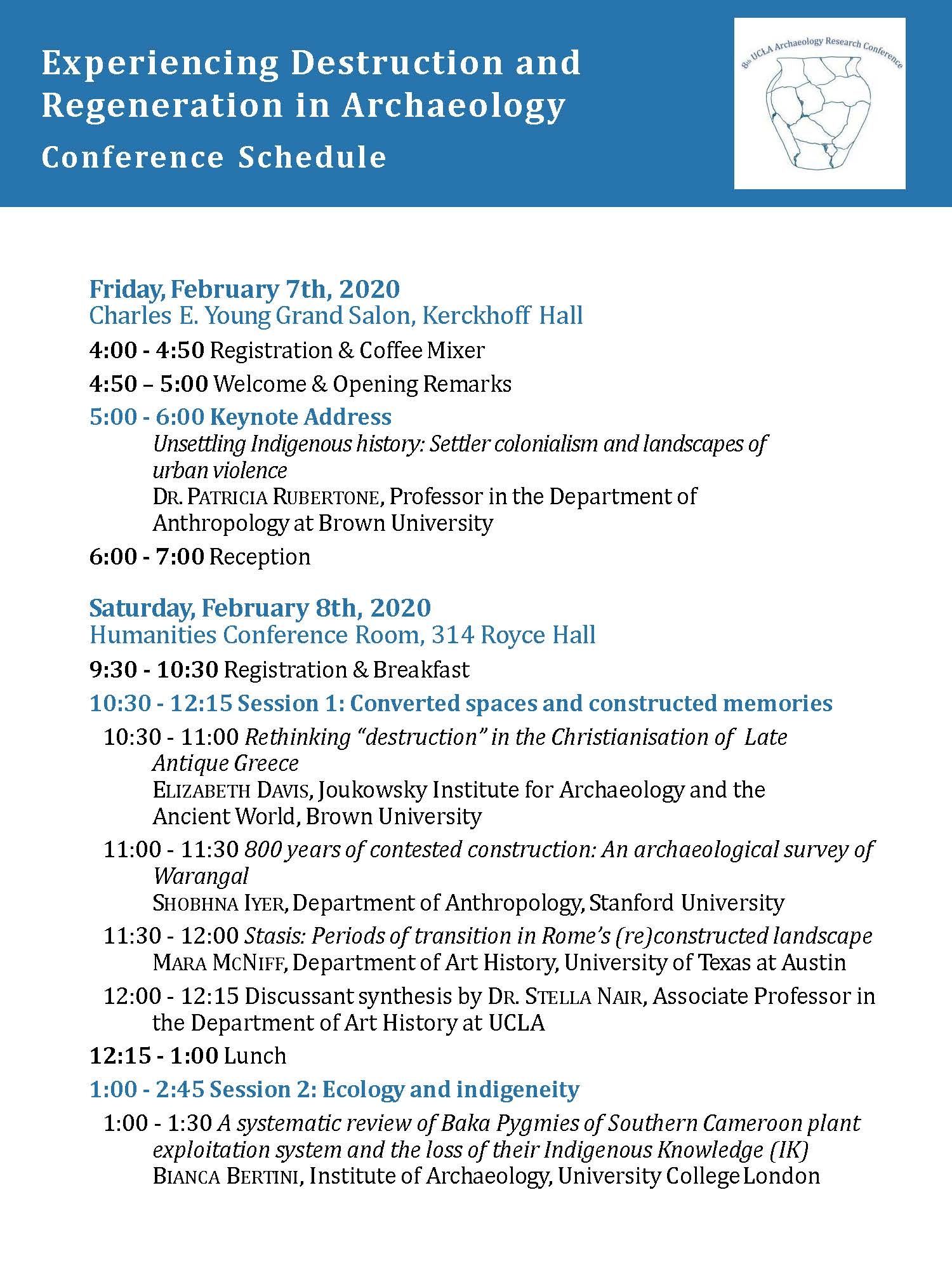
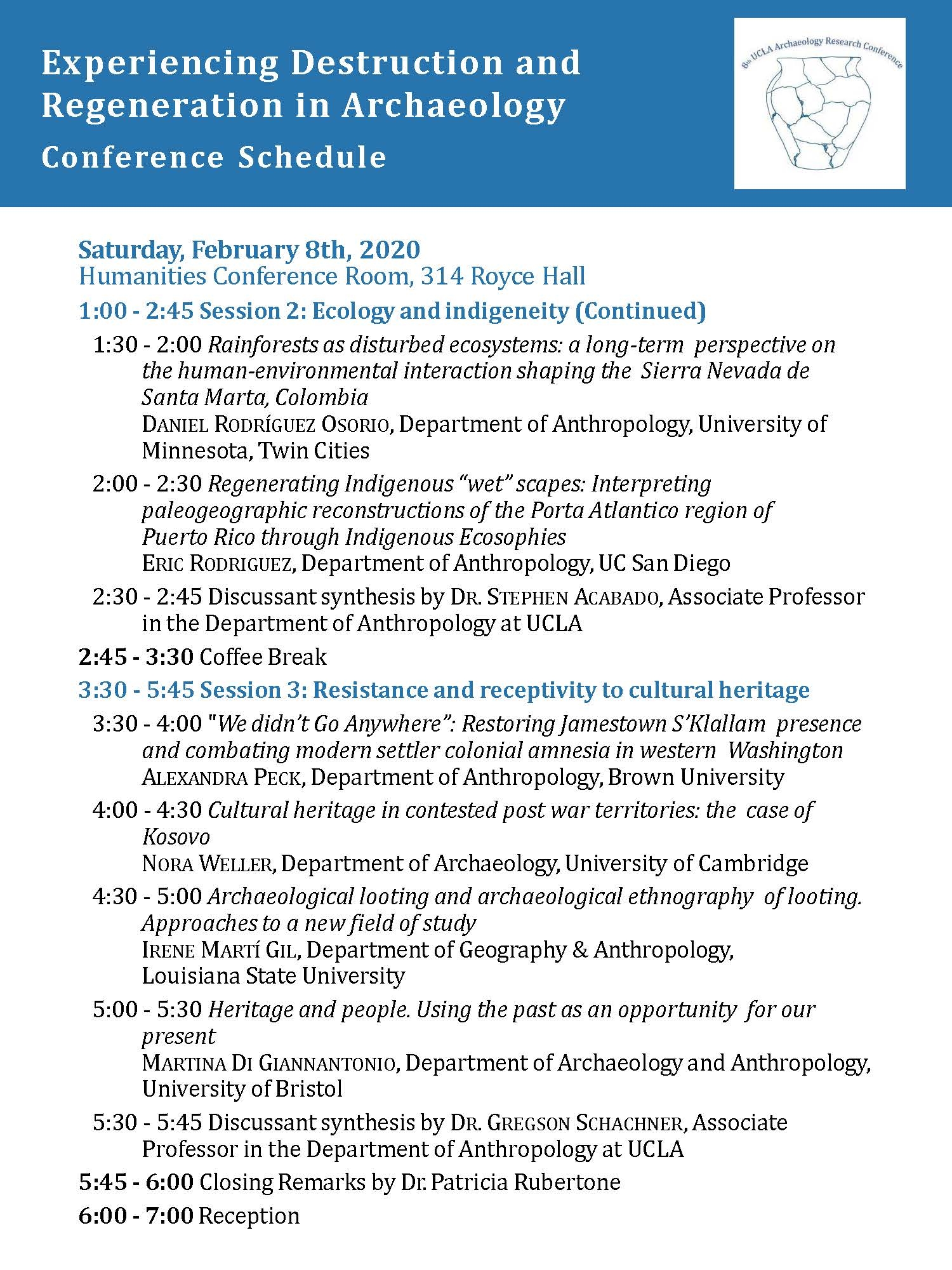
The Graduate Student Association of Archaeology, an affiliate of the Cotsen Institute of Archaeology, will host the 8th Graduate Archaeology Research Conference. This conference will take place on the UCLA campus in Los Angeles, California, on February 7th and 8th, 2020. Accepted applicants will give 20-minute presentations followed by brief question-and-answer sessions.
 Program with Abstracts - 8th Graduate Archaeology Research Conference.pdf
The talks will cover interdisciplinary approaches to this year’s theme on “Experiencing Destruction and Regeneration in Archaeology.” 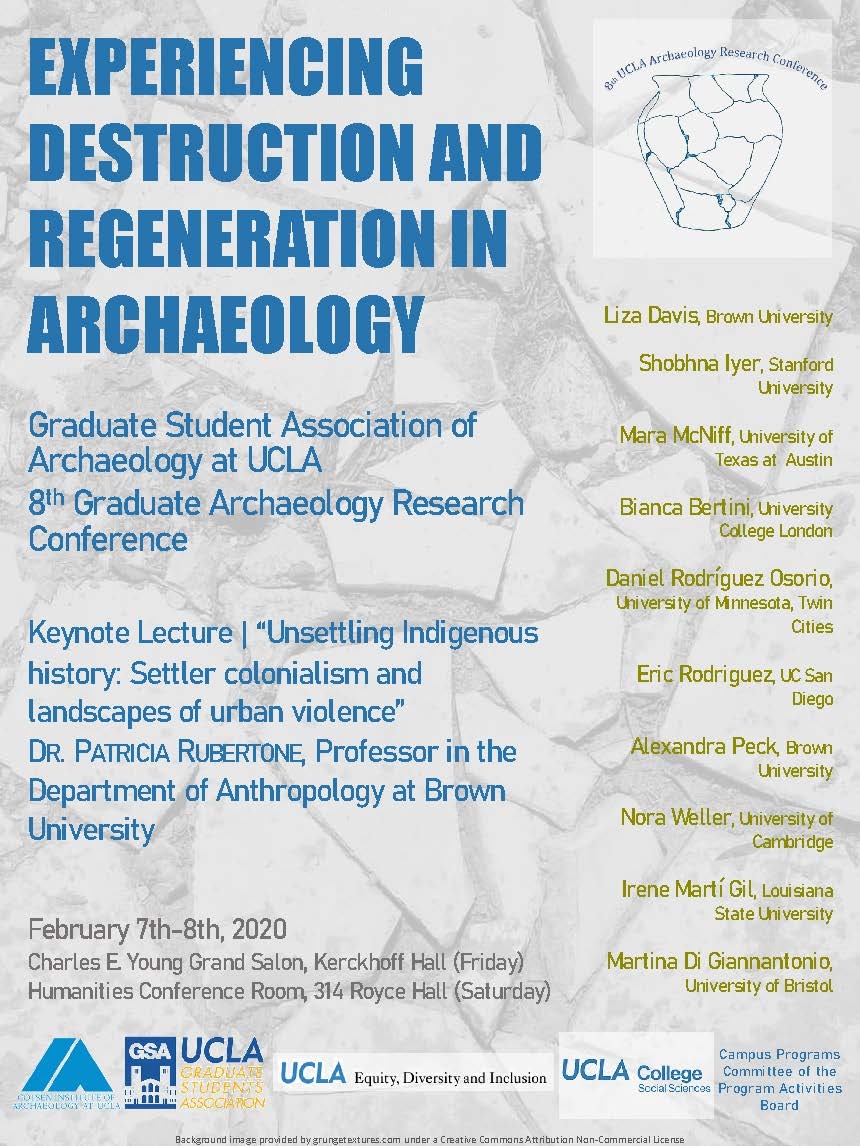 Speakers will discuss the many contexts in which uncontrolled or deliberate destruction—as well as regeneration, reconstruction, and re-use—plays a part in the archaeological past and present. Destruction lies at the heart of archaeological inquiries, seen in every context from the collapse of civilizations to the deliberate breaking of ceramics in ritual settings. Destruction of archaeological remains also occurs in the present through the neglect or eradication of material heritage for economic, sociopolitical or environmental reasons. Simultaneously, reconstruction and regeneration penetrate every aspect of archaeology—seen in current heritage management practices as well as in the material traces of ancient and modern peoples’ efforts at recovery, rebuilding and re-use.
Speakers are encouraged to approach this topic from an experiential perspective, as moments of destruction and reconstruction or regeneration provide communal sensorial experiences, producing and reproducing social memory and shared identities. Archaeology, as a discipline rooted in materiality, can access these senses at their most basic level. Exploring such experiences of destruction and regeneration allows us to better understand the mindsets of past and present peoples alike as they destroyed, rebuilt and remembered.
Keynote speaker Dr. Patricia Rubertone, Professor of Anthropology at Brown University, will address instances of destruction and regeneration through the intersecting lenses of archaeology, history and ethnography. She will discuss commemoration and erasure of Native American monuments in New England in the context of colonialism, as well as the implications of documentary genocide and urban renewal for recovering indigenous pasts.
Please RSVP by February 3rd here.
Email any questions to archaeogradcon@ioa.ucla.edu. The call for papers can be downloaded here.
Contact Conference organizers
Email archaeogradcon@ioa.ucla.edu
Phone
Cotsen faculty Jason De León will be a guest on the podcast "Armchair Expert with Dax Shepard" on February 1, 2020. The UCLA Department of Anthropology is hosting a live taping of the podcast at 6:00pm in Korn Convocation Hall at UCLA.
De León will also be speaking on February 11th as part of the Archaeology 50th Anniversary Lecture Series.
Dax Shepard
BA '00, Anthropology
in conversation with
Jason De León
Professor
UCLA Department of Anthropology
UCLA Department of Chicana and Chicano Studies

Saturday, February 1, 2020
6:00 p.m.
Korn Convocation Hall
UCLA

Registration required.
Seating is first come, first served and is not guaranteed.
Self-pay parking available in Structure 4
About Armchair Expert:
Armchair Expert is a weekly podcast hosted by American actor, director, and writer Dax Shepard and Emmy-nominated Monica Padman. Each podcast features Shepard and Padman interviewing celebrities as well as journalists and academics about "the messiness of being human". Click here to learn more about Armchair Expert.
Contact
Phone
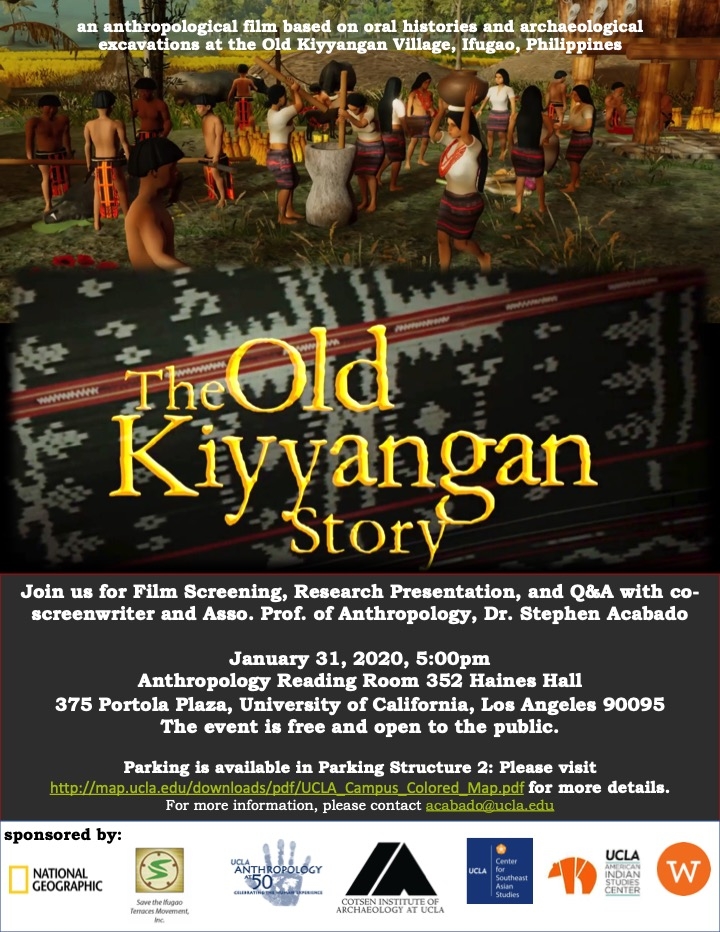
The Old Kiyyangan Story, an anthropological film based on oral histories and archaeological excavations at the Old Kiyyangan Village, Ifugao, Philippines, will be presented January 31 at 5pm in the Anthropology Reading Room. In addition to the film screening, there will be a research presentation and Q & A with co-screenwriter and Associate Professor of Anthropology, Dr. Stephen Acabado. Acabado is a core faculty member of the Cotsen Institute of Archaeology. The event is free and open to the public.
A trailer for the film can be viewed here.
Contact Stephen Acabado
Phone
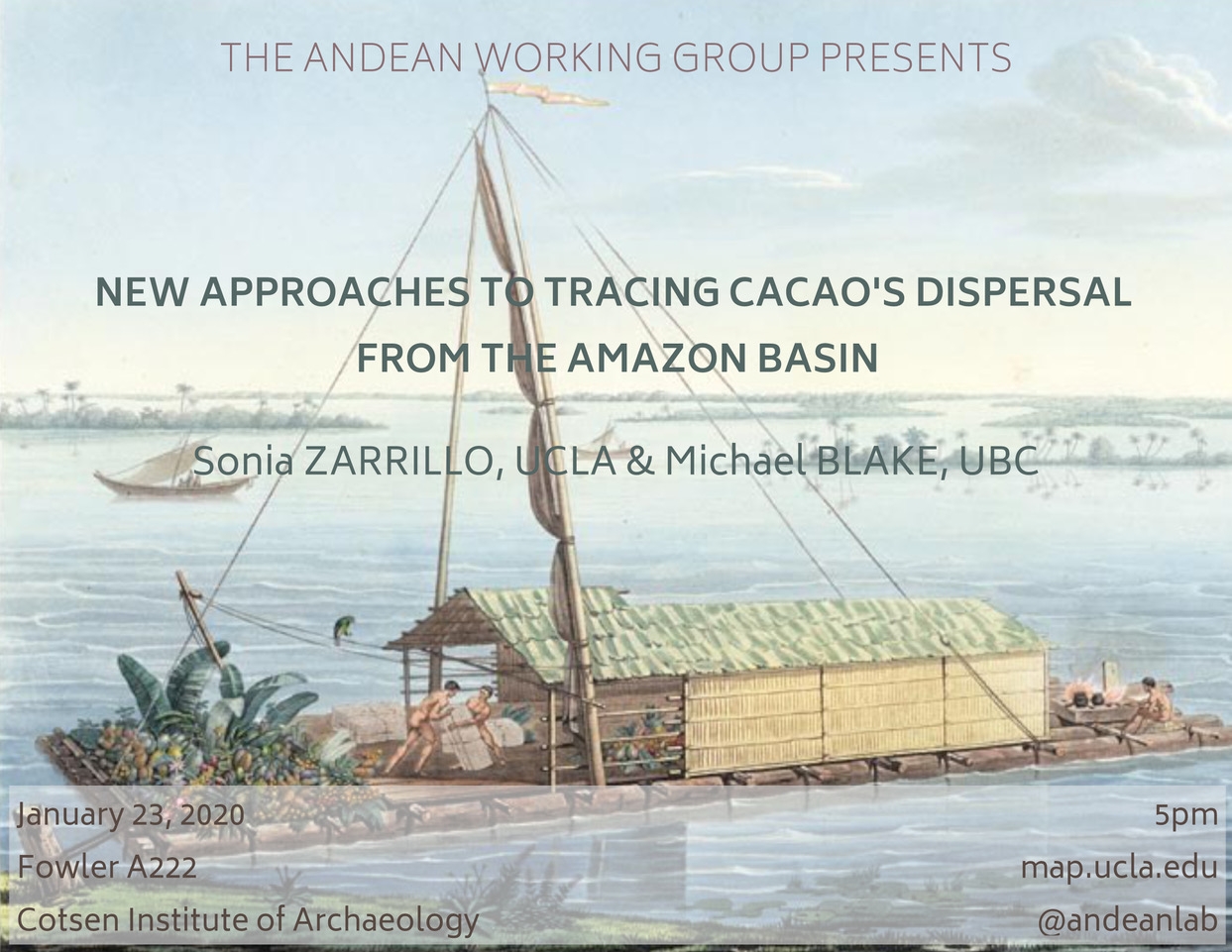
Dr. Sonia Zarrillo will be presenting on "New Approaches to Tracing Cacao's Dispersal from the Amazon Basin” on January 23rd at 5pm in the Cotsen Seminar Room (A222). This event was sponsored by the Andean Working Group.
Contact Louise Deglin
Phone
Fowler Curator of Archaeology Wendy Giddens Teeter will discuss the importance of the collaborative web-based project Mapping Indigenous Los Angeles and her experiences working with the Tongva and indigenous communities to forefront the multiple historical layers of Los Angeles. She will also speak about national and international repatriation efforts as UCLA’s Native American Graves Protection and Repatriation Act (NAGPRA) Coordinator, which has helped Native American tribes regain their ancestors and cultural heritage as well as provide a platform to share their voices in online exhibitions, such as Carrying our Ancestors Home.
For more information, please visit: https://www.fowler.ucla.edu/events/lecture-by-wendy-teeter-mapping-indig...
Contact
Phone
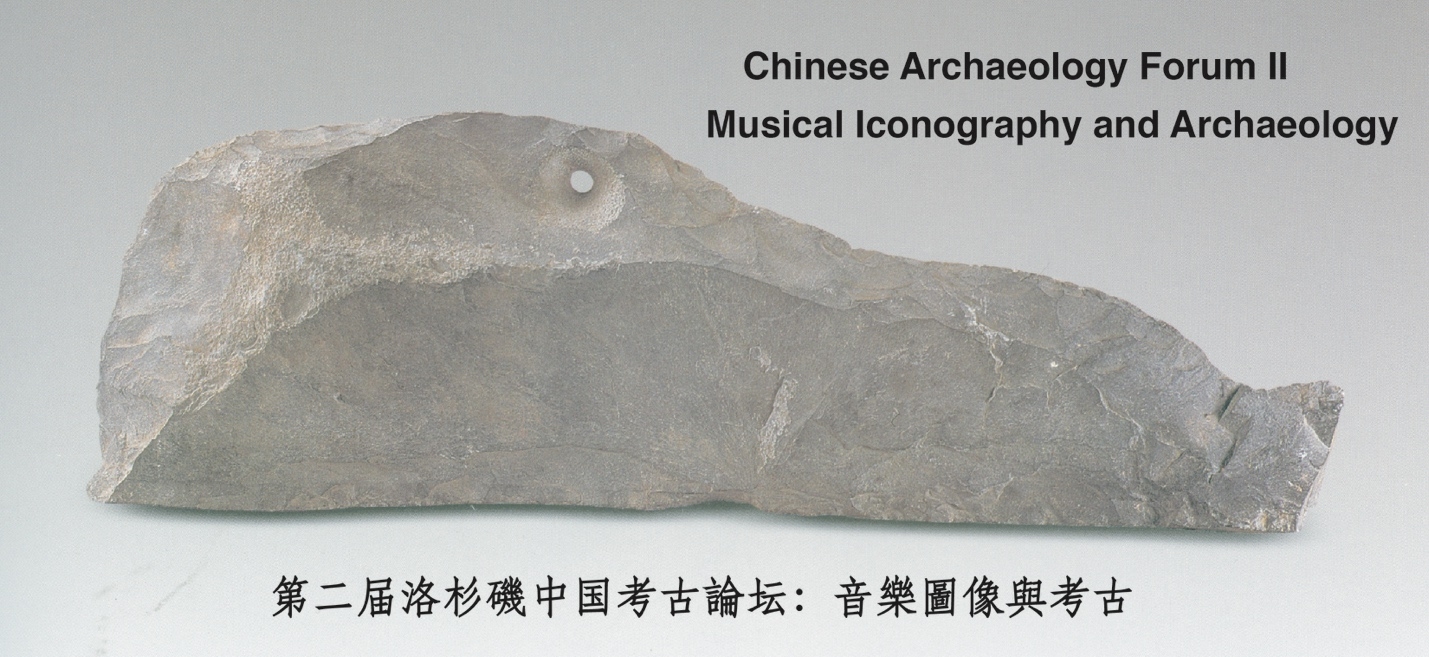
Presenters 報告者:
1:00-1:30 Kirie Stromberg 益田雾繪 (UCLA 加州大學洛杉磯分校): Beyond Form:
Preliminary Thoughts on Music and Visual Abstraction in Early China 早期中國的音樂與視覺
抽象化表达
1:40-2:20 Gao Jiangtao 高江涛 (CASS 中國社會科學院考古研究所):Comprehensive Analysis
of Musical relics Unearthed from Taosi Site 鼍鼓逢逢:陶寺遗址出土乐器综析
2:30-3:00 Zhang Wenjie 張聞捷 (Xiamen University 厦门大學) New Thinking on the Chime
Bells of Wangsun Gao 對王孫誥編鐘的一些新思考
3:10-3:40 Li Guangming 李光明 (UCLA 加州大學洛杉磯分校) The Tonal Structure of the
Yajiang Chimes: On the Missing Shang Note in Western Zhou Music and Guanzi Tonal Theory
从亚弜编铙音列结构看周乐戒商及管子生律法之由来
3:50-4:20 Zhu Guowei 朱國偉 (China University of Mining and Technology 中國礦業大學)
A review on experimental music archaeology and its prospect in China 實驗音樂考古研究綜述
及其在中國的研究展望
4:30-5:00 Lee Mei-Yen 李美燕 (National Pingtung University 國立屏東大學) Western
Cultural Origin of Musical Instruments Found on the Musical Icons in Yungang Grottoes 雲岡石
窟音樂圖像中的西方源流
Discussants 點評者:
Lothar Von Falkenhausen 罗泰 (UCLA 加州大學洛杉磯分校藝術史系)
Helen Rees 李海倫 (UCLA 加州大學洛杉磯分校民族音樂學系)
Sponsored by 资助机构:
Henry Luce Foundation 路思基金會
UCLA Cotsen Institute of Archaeology 加州大學洛杉磯分校蔻岑考古研究所
UCLA Center for Chinese Studies加州大學洛杉磯分校中國研究中心
UCLA East Asian Library 加州大學洛杉磯分校東亞圖書館
Contact Sumiji Takahashi
Email sutakahashi@ioa.ucla.edu
Phone 310-825-4169
Archaeology of Ancient Israel Lecture Series
Speaker:
Avraham Faust (Bar-Ilan University)
Moderated by:
Dr. Aaron Burke (NELC)
Sponsored by:
Kershaw Chair for Ancient Eastern Mediterranean Studies
Co-Sponsored by:
Department of Near Eastern Languages and Cultures
Cotsen Institute of Archaeology
Alan D. Leve Center for Jewish Studies
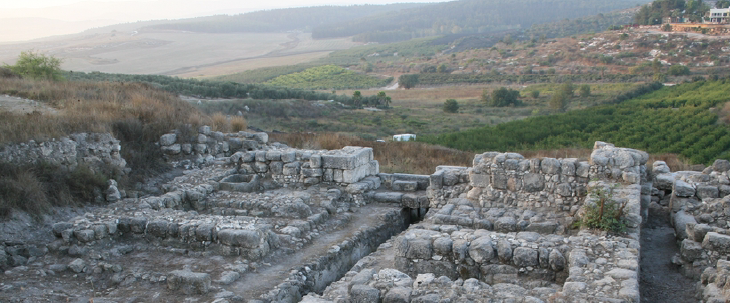
The United Monarchy – the famed kingdom of David and Solomon – is at the center of a heated debate. While until 25 years ago there was a consensus that David and Solomon were historical figures who ruled over fairly large territories, it is now questioned by many who believe either that these kings were either petty chiefs controlling a limited territory around Jerusalem or that they did not even exist. Given these doubts, the archaeological evidence has come to the center of discussion stage. A broad examination of the nature of the Iron I-II transition, however, reveals major changes in practically every aspect of life, from settlement patterns to various aspects of material culture, including pottery form and decoration, and architectural developments. While each change could, in theory, be a result of a number of causes, a broad analysis of all the processes and transformations, and especially their sequencing in time and space, greatly narrows down the possible options. It is therefore the aim of the present lecture to briefly present the sweeping changes that accompanied the Iron I-II transition, to reconstruct (temporally and spatially) the processes of growing social complexity that they reflect, and subsequently to examine the implications of this analysis on the debate over the historicity of the so-called United
Contact Department of Near Eastern Languages and Cultures
Email nreast@humnet.ucla.edu
Phone

Speaker:
Megan Perry
East Carolina University
Associate Professor of Biological Anthropology
Abstract:
The mysterious Nabataeans, builders of the magnificent city of Petra, have long fascinated scholars and the public. Scant archaeological research and minimal textual sources have not clarified the shift from a primarily nomadic encampment in the late 4th century BC into a major capital city by the 1st century BC. Our understanding of Petra’s urban life recently has been transformed with the excavation of tombs within the ancient city. The human skeletal remains from these tombs have illuminated the origins of the city’s residents, their disease profiles, and what foods they relied on in this desert environment. This lecture demonstrates how Petra’s dead can inform what life was like in this ancient city.
Contact Aaron A. Burke (aaburke@ucla.edu) for more information.
Contact Sumiji Takahashi
Email sutakahashi@ioa.ucla.edu
Phone 310-825-4169
- ‹ previous
- 4 of 8
- next ›